Electric Cars Highlight Tokyo Auto Show
November 3, 2009 by admin
Filed under -Other EVs-, Nissan Leaf
Below is The Auto Channel’s coverage of the 2009 Tokyo Auto Show. Unique, compact electric cars were the focus of the event. First up in the video is the Mazda Kiyora, which actually is not an electric vehicle at all, but is propelled by a Mazda SKY-G highly-efficient 1.3 liter direct injection gasoline engine. It must have been included by mistake, but is nevertheless, a very low-consumption vehicle. The Toyota FT-EV is indeed an electric vehicle that gets 60 miles on a charge and can reach speeds of up to 70 mph. It’s so short, it looks like you could park it perpendicular on the street. The Nissan Leaf, further along than the other concept vehicles, should get you 100 miles on a charge and 87 mph on the highway. The Land Glider is another tilting EV that gets 60 miles on a charge and only achieves a top speed of 40 mph, so irrelevant in other words.
Autobloggreen Covers Nissan Leaf
August 2, 2009 by admin
Filed under Nissan Leaf
Source: Autobloggreen.com
2010 Nissan Leaf electric car: In person, in depth — and U.S. bound
It would be easy to paint Nissan as late to the burgeoning U.S. green party, as the company essentially only counts the Altima Hybrid to sell among its alt-fuel offerings – and that sedan utilizes technology borrowed from Toyota, and it’s only sold in a few states in small volumes. While that may be the case, Nissan says their near-term prospects are really quite different. While the company has admittedly been cautious in marketing alt-fuel vehicles in North America, they have been hard at work developing electric vehicles – as well as the advanced lithium-ion batteries to support them – since 1992. What’s more, officials say they are now singularly well-placed to leapfrog “transitional” powertrain solutions like gas-electric hybrids in favor of genuine zero-emissions vehicles, and they are promising that their first pure-electric car will reach U.S. shores late next year.
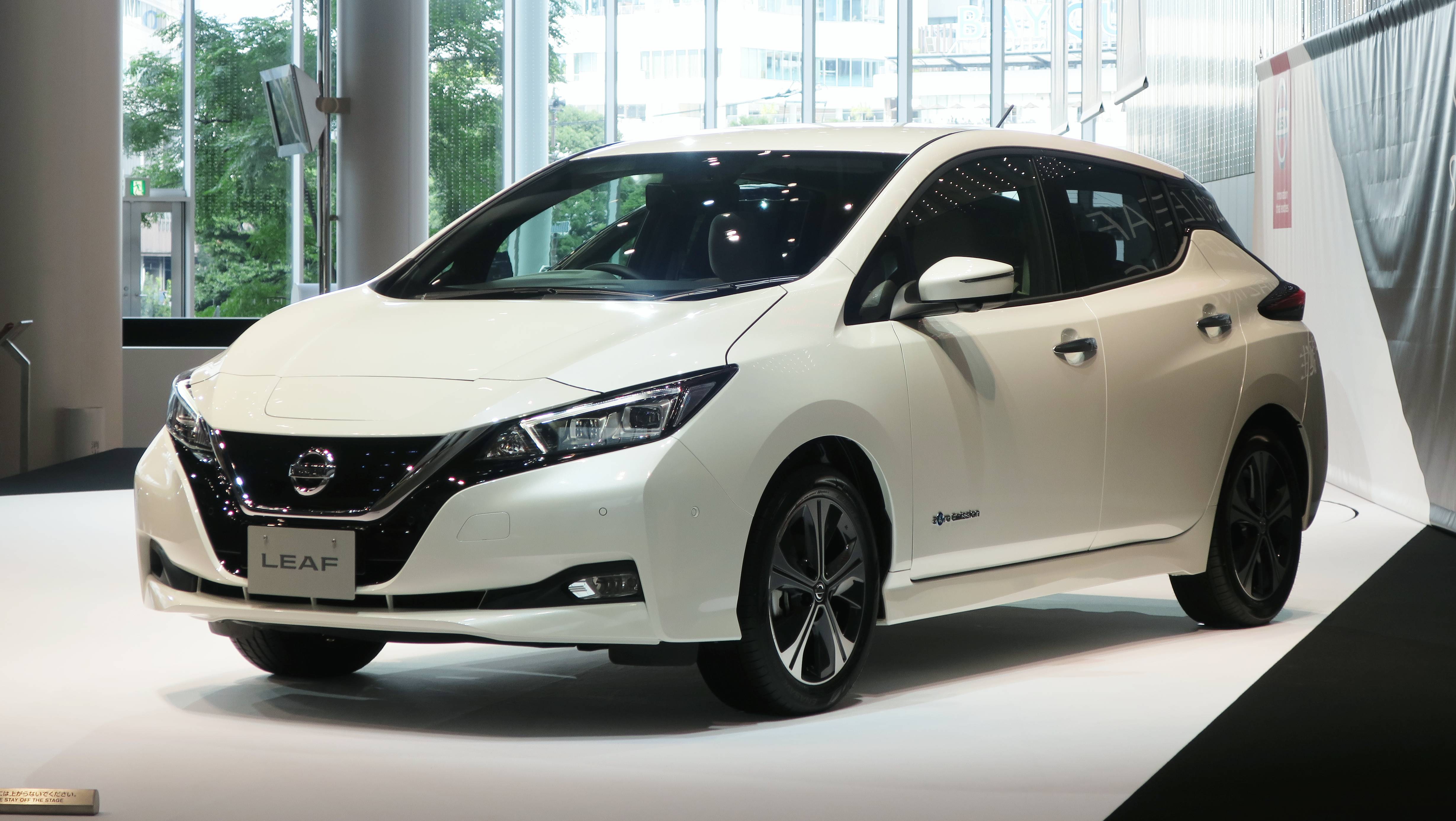
That car, the Nissan Leaf shown here, is the reason we find ourselves in the company’s brand-new Yokohama headquarters today. Designed as a four-to-five seat, front-drive C-segment hatchback, Nissan says the Leaf is not just for use as a specialty urban runabout, but rather, it was designed as an everyday vehicle – a “real car” whose 160-kilometer+ (100 mile) range meets the needs of 70% of the world’s motorists. In the case of U.S. consumers, Nissan says that fully 80% of drivers travel less than 100km per day (62 miles), making the Leaf a solid fit for America’s motoring majority, even taking into account power-sapping external factors like hilly terrain, accessory draw, and extreme temperatures.
We were afforded an advance look at the Leaf ahead of the car’s unveiling today, and while it was a hands-off affair, we did have the chance to formulate some in-the-metal first impressions and take a deep dive into the car’s technology. Click through to the jump to learn all about it.
As we noted, it would be fair to say that in North America, at least, Nissan has been something of a laggard in publicly promulgating and promoting an alternative fuel strategy. Instead, in recent years, the Japanese automaker has seemingly focused on burnishing its performance image, bringing powerhouse offerings like the GT-R and the 370Z to market –not to mention augmenting their lineup with accomplished new crossovers and luxurious Infiniti vehicles. Not that we’re complaining, mind, but the company’s apparent focus on these segments has had us wondering about how the automaker views its long-term energy responsibilities and prospects.

During that same time period, Nissan’s fellow countrymen at Toyota and Honda have made very public strides in not only offering hybrid vehicles, but also marketing the lifestyle and successfully positioning themselves as benevolent, eco-friendly corporations. Similarly, European automakers like Volkswagen and Mercedes-Benz have invested heavily and openly in clean-diesel technology, and American automakers have produced a startling number of keenly fuel-efficient gasoline-engined models, not to mention hybrids and scads of E85-capable vehicles - all while publicly priming us for extended-range offerings like the forthcoming Chevrolet Volt. Nissan says they have a lot of alternative propulsion vehicles in the pipeline for America – including hybrids – but the Leaf is the first concrete evidence we have of that commitment.
A Question of Style
Interestingly, unlike the current alt-fuel darlings from Toyota and Honda, Nissan has purposefully eschewed a fastback shape for a more formal five-door appearance. Shiro Nakamura, Nissan’s senior vice president and chief creative officer (read: styling director) admits he wanted the car to be unique, but not so bizarre as to be off-putting to most car buyers:
By that measure, the more upright yet unique Leaf is a success – it is a slippery shape with real passenger space, yet it doesn’t resort to visually polarizing aerodynamic tricks like faired-in wheel housings and to maximize aero. Instead, it has a smooth face (secreting two charging ports hiding beneath the Nissan logo), strangely prominent blue-tinted headlamps that manage airflow as much as they do nighttime vision, and a roofline whose rearmost pillar reminds us of another Nissan – the Murano. The Leaf has an almost Gallic rump that recalls that of the Versa, a design that in turn reminds us of offerings from Nissan’s European partner, Renault.

Underbody aero management has also been a clear priority, as the Leaf looks to have a nearly smooth belly thanks to the flat battery-pack subframe, and there are functional diffuser elements beneath the rear bumper cap to detach air from the car. It might have been wishful thinking, but we also couldn’t help noticing that the alloy wheel pattern we were shown reminds us of those employed on many Nineties-era 300ZX models. At the end of the day, we wouldn’t call the Leaf’s exterior pretty, but neither would we call it offensive – not unlike the Prius and Insight, then.
The interior is at once handsome and spacious, with what appears to be plenty of room both front and rear for real-sized adults, and the cargo area is very deep, as it is unencumbered by a gas tank assembly (the batteries are mounted beneath the seats within the wheelbase). The center stack is production and looks slick, but its smooth finish flush buttons may also be hard to operate by feel on-the move. The digital instrument cluster display and the drive controller (we can’t really call it a gearshift in an EV now, can we?) are also production pieces, and they look well finished inviting, as does the interior as a whole.

While there will probably be a few discreet changes to the Leaf (non-showcar paint, slightly different interior fabrics, etc.), this isn’t a concept vehicle – Nissan assured us that you are looking at the Real McCoy, the vehicle headed for select American, Japanese, and European showrooms next year.

Lithium Ion Becomes a Reality:
Powered by a unique array of thin, laminated lithium ion cells capable of delivering over 90 kW of power, the Leaf’s front-mounted electric motor delivers 80 kW (107 horsepower) and a healthy 280 Nm of torque (208 pound-feet), and it promises brisk and silent off-the-line power, with acceleration from a stop comparable to that of the company’s Infiniti G35. And as Nakamura-san noted, the Leaf has a top speed of over 140 km/h (87 mph).
Perhaps more important than the Leaf’s top speed are its battery’s charging characteristics. In this regard, the car’s under-floor mounted assembly of 48 lithium ion modules (each laptop-sized module is comprised of four magazine-sized cells) offers a number of charging strategies. To yield a full charge, a 200-volt, single-phase AC charger takes less than eight hours, and topping off the battery from a 100 volt single-phase standard home wall outlet will take somewhere around twice that time, so prospective Leafmakers would do well to get 220 volt hookup like their clothes dryer uses out in their garage.

More impressive is the battery pack’s 50 kW DC fast-charge capability, which is capable of accepting an 80% charge in less than 30 minutes, or an extra 50 km (31 miles) worth of range in about 10 minutes. For that, though, you’ll need access to a special dedicated (and at around $45,000 – expensive) three-phase charger, which various cities around the globe have begun installing as part of their own greening strategies. The executives we spoke with says they are working with local governments in the States and around the world to help build supporting infrastructure, but they admit the automaker has no plans to financially support the networks themselves, and fast chargers like the one we experienced in Yokohama are clearly cost-prohibitive for private ownership.
Make no mistake, though, as despite clever construction methods, the Leaf’s batteries remain heavy, at around 200 kg per car (over 440 pounds). Despite this, Nissan projects that the car’s total weight will be similar to that of a comparable gas car because the electric motor is lighter than a traditional internal-combustion engine and because there is no need for a conventional transmission. Of course, there is the added bulk of a power inverter, but on the whole, Nissan believes the car’s center-of-gravity will be lower than an I.C. car, so handling might actually be better than the aforementioned Versa.
Nissan sees the capability for dramatic user cost-savings versus a traditional internal-combustion equivalent. Using typical Japanese market figures as a starting point, the automaker says an equivalent internal-combustion vehicle’s fuel consumption figure of 20 km/liter (47.5 mpg U.S.) over 1,000 km/month (620 miles) costs about 6,000 yen per month – about $63 U.S. dollars. Conversely, assuming the same operating parameters for the Leaf (using a charge cycle using cheaper nighttime energy rates), Nissan sees an operating cost for its ZEV of just 1,200 yen per month ¬– less than $13. Of course, American drivers will likely pile on far more miles per month on average, and our energy costs differ, but the point is clear – the automaker sees the Leaf as having real money-saving potential.
Who, What, When, Where, Why, and How?
While Nissan promises to deliver the Leaf to its first American customers in late 2010, it isn’t immediately clear where it will be made available, to whom, and how. By that we mean the zero-emissions vehicle will likely be marketed in select stateside cities that have already committed to building some of the necessary infrastructure to support electric vehicles, and the Leaf likely won’t be available for purchase, it will probably be a lease-only proposition – at least initially.
Officials are still working out the specifics on a global market-by-market basis, but in the U.S., at least, they are aiming for a cost similar to their midsize Altima offering – presumably after all local and federal government incentives for ZEV are factored in. Initial allotments of the Leaf will probably be leased, with the batteries also being a leased proposition, minimizing consumers’ up-front risks for adopting this new style of vehicle and allowing for easier, more cost-effective upgrades as technology improves. As has been done with other automakers’ alternative energy pilot programs in the past, the Leaf will probably be distributed to fleets and very select customers at first – a more widespread commercial push isn’t expected until 2012.

As stated earlier, the Leaf will probably be initially marketed in those U.S. cities that have committed to building the necessary infrastructure to support EVs – places like Phoenix and Tucson in Arizona; San Diego and Sonoma County in California; Raleigh, North Carolina; Oak Ridge, Tennessee; and Seattle, Washington. Nissan says it has established 27 partnerships with local governments around the world, and more are on the way. If you’re outside of such areas, Nissan says it won’t discourage you from becoming an owner/lessee, but obviously home charging will need to be sufficient.
Finding Fuel
How will Leaf drivers find these public charging stations? Every example will be equipped with an integrated computer system that is connected to a GPS system and global data center, allowing the Leaf to display its “reachable area” on its sat-nav screen, as well as the location of nearby charging stations. That same advanced IT system can also communicate with the owner’s smart phone, sending them emails to let them know their vehicle’s state of charge, allow users to pre-cool or pre-warm the Leaf while it’s charging (thus drawing power from the grid and not depleting the onboard batteries), and the system can even be programmed to charge in the middle-of-the-night to take advantage of lower energy costs. When we asked, Nissan officials said they did not know if the car’s communications system will require a monthly service fee along with it, or if that will simply be rolled into the cost of the vehicle.

Batteries Not Included?
While it hasn’t committed to anything yet, Nissan officials say they are shooting for similar warranty coverage to that of their more conventional offerings. Those vehicles come standard with three years/36,000 mile coverage, and powertrain coverage of five years/60,000 miles, and it will be interesting to see if Nissan can match those figures for the vehicle, it’s electronic motor, and the expensive battery pack (estimated replacement cost: $10,000).
For our driving enthusiast audience, perhaps the biggest question is: How will these cars perform? We were afforded a very brief test-drive in the company’s latest prototype EV, a Versa-bodied model that is said to be representative of the 2010 production car’s capabilities, and we’ll have a more detailed report for you shortly. At first glance, we’re impressed and cautiously optimistic that Nissan has done their homework. However, the biggest hurdle to an electrified motoring experience – infrastructure – is almost entirely out of the automaker’s hands. Will America’s cash-strapped governments be able to make electric vehicle ownership a viabile proposition for most of the nation’s citizens? Only time will tell. While you stew on that nugget, be sure to check out the official press releases and our gallery of high-res images below.
PRESS RELEASE:
NISSAN UNVEILS “LEAF” – THE WORLD’S FIRST ELECTRIC CAR DESIGNED FOR AFFORDABILITY
AND REAL-WORLD REQUIREMENTS
Event ushers in a new era for Nissan and a new era for mobility
YOKOHAMA, (Aug. 2, 2009) - Nissan Motor Co., Ltd. today unveiled Nissan LEAF, the world’s first affordable, zero-emission car. Designed specifically for a lithium-ion battery-powered chassis, Nissan LEAF is a medium-size hatchback that comfortably seats five adults and has a range of more than 160km (100 miles) to satisfy real-world consumer requirements.
NISSAN LEAF
Slated for launch in late 2010 in Japan, the United States, and Europe, Nissan LEAF ushers in a new era of mobility – the zero-emission era. The car is the embodiment of Nissan’s radical, transformative vision for the future and the culmination of decades of investment and research.
“Nissan LEAF is a tremendous accomplishment – one in which all Nissan employees can take great pride,” said Nissan President and CEO Carlos Ghosn. “We have been working tirelessly to make this day a reality – the unveiling of a real-world car that has zero – not simply reduced – emissions. It’s the first step in what is sure to be an exciting journey – for people all over the world, for Nissan and for the industry.”
Key characteristics of the LEAF include:
1) Zero-emission power train and platform
2) Affordable pricing
3) Distinctive design
4) Real-world range autonomy – 160km (100 miles)
5) Connected Mobility: Advanced intelligent transportation (IT) system
The “LEAF” name is a significant statement about the car itself. Just as leaves purify the air in nature, so Nissan LEAF purifies mobility by taking emissions out of the driving experience. Pricing details will be announced closer to start of sales in late 2010; however, the company expects the car to be competitively priced in the range of a well-equipped C-segment vehicle. Additionally, Nissan LEAF is expected to qualify for an array of significant local, regional and national tax breaks and incentives in markets around the world. As an added benefit, because the vehicle has less mechanical complexity than a traditional gasoline-powered car, Nissan LEAF is designed to be friendly to the wallet as well as to the environment.
ZERO-EMISSION MOBILITY
Nissan LEAF is powered by laminated compact lithium-ion batteries, which generate power output of over 90kW, while its electric motor delivers 80kW/280Nm. This ensures a highly responsive, fun-to-drive experience that is in keeping with what consumers have come to expect from traditional, gasoline-powered automobiles.
Unlike internal-combustion engine (ICE) equipped vehicles, Nissan LEAF’s power train has no tail pipe, and thus no emission of CO2 or other greenhouse gases. A combination of Nissan LEAF’s regenerative braking system and innovative lithium-ion battery packs enables the car to deliver a driving range of more than 160km (100 miles) on one full charge*. (*US LA4 mode)
Extensive consumer research demonstrates that this range satisfies the daily driving requirements of more than 70% of the world’s consumers who drive cars.
And, Nissan’s approach makes charging easy and convenient. Nissan LEAF can be charged up to 80% of its full capacity in just under 30 minutes with a quick charger. Charging at home through a 200V outlet is estimated to take approximately eight hours – ample time to enable an overnight refresh for consumer and car alike.
REAL-WORLD CAR
The engineers and designers behind Nissan LEAF worked to create a competitively priced real-world car that would enable Nissan to lead mobility into the zero-emission era. To ensure comfort, spaciousness and cargo capacity, Nissan LEAF employs a completely new chassis and body layout.
“Our car had to be the world’s first, medium-size, practical EV that motorists could afford and would want to use every day. And that’s what we’ve created. The styling will identify not only Nissan LEAF but also the owner as a participant in the new era of zero-emission mobility,” said Masato INOUE, Product Chief Designer.
DISTINCTIVE DESIGN
Even the smallest details can yield tremendous effect.
Nissan LEAF’s frontal styling is characterized by a sharp, upright V-shaped design featuring long, up-slanting light-emitting diode (LED) headlights that employ a blue internal reflective design that announces, “This car is special.” But the headlights do more than make a statement. They are also designed to cleverly split and redirect airflow away from the door mirrors, thus reducing wind noise and drag. And, the headlights provide yet one more benefit in that they consume just 10 percent of the electricity of conventional lamps, which helps Nissan LEAF to achieve its world-class range autonomy.
Through bright trim colors inside, Nissan LEAF creates a pleasing and stylish cabin environment. An environmentally friendly “blue earth” color theme originates from the Aqua Globe body color of Nissan LEAF’s introductory model. This theme is carried into the interior through blue dashboard highlights and instrument illumination.
CONNECTED MOBILITY IT SYSTEM
Nissan LEAF employs an exclusive advanced IT system. Connected to a global data center, the system can provide support, information, and entertainment for drivers 24 hours a day.
The dash-mounted monitor displays Nissan LEAF’s remaining power – or “reachable area” – in addition to showing a selection of nearby charging stations.
Another state-of-the-art feature is the ability to use mobile phones to turn on air-conditioning and set charging functions – even when Nissan LEAF is powered down. An on-board remote-controlled timer can also be pre-programmed to recharge batteries.
“The IT system is a critical advantage,” says Tooru ABE, Chief Product Specialist. “We wanted this vehicle to be a partner for the driver and an enhancement for the passengers. We also wanted this vehicle to help create a zero-emission community, and these IT features will help make that possible.”
HOLISTIC APPROACH TO ZERO-EMISSION MOBILITY AND ECO-FRIENDLY INNOVATION
Nissan LEAF is a critical first step in establishing the era of zero-emission mobility; however, Nissan recognizes that internal-combustion engine (ICE) technologies will play a vital role in global transportation for decades to come. Because of this, Nissan is implementing its zero-emission vision through a holistic approach, which provides consumers a comprehensive range of eco-friendly technologies from which to choose.
For some consumers, Nissan LEAF will be the perfect match, and the only car they will ever need. For others, Nissan LEAF will be a logical addition to the family fleet – the optimal choice for the daily commute, for example.
While zero-emission is the ultimate goal, the company is committed to ongoing innovation in eco-friendly technologies that increase efficiency and reduce emissions. As a result, Nissan offers a comprehensive suite of automotive technologies, including CVT, Idle Stop, HEV, Clean Diesel, and ongoing research and investment in FCV technology.
WORLDWIDE PARTNERS
Zero-emission mobility programs under the banner of the Renault-Nissan Alliance include partnerships with countries such as the UK and Portugal, local governments in the Japan and the USA, and other sectors, for a total of nearly 30 partnerships worldwide.
In these partnerships major efforts focus on three areas:
1) Development of a comprehensive charging infrastructure through public and private investment,
2) Incentives and subsidies from local, regional, and national governments, and
3) Public education on the individual and societal benefits of zero-emissions mobility.
ZERO-EMISSION VEHICLE PRODUCTION
Nissan LEAF is the first in the company’s forthcoming line of EVs and is a major milestone in the realization of the Renault-Nissan Alliance’s vision for zero-emission mobility. The first of Nissan’s EVs will be manufactured at Oppama, Japan, with additional capacity planned for Smyrna, Tennessee, USA. Meanwhile, lithium-ion batteries are being produced in Zama, Japan, with additional capacity planned for the USA, the UK and Portugal, and other sites for investment are under study around the world.
ABOUT NISSAN MOTOR CO., LTD.
Nissan Motor Co., Ltd. is a global automotive company with vehicle sales of 3.411 million in 2008. Nissan is present in all major auto markets worldwide, selling a comprehensive range of cars, pickup trucks, SUVs, and light commercial vehicles.
NISSAN BLUE CITIZENSHIP
Nissan is committed to making a better world through its commitment to corporate social responsibility. This includes programs that focus on technological innovations that focus on people and care for the planet. Our vision for zero-emission mobility is an outgrowth of our CSR approach, which we call Blue Citizenship. Together, we are working with our Alliance partner, Renault, to make a better world through zero-emission mobility.
For more information, please visit the Nissan Zero-Emission website:
http://www.nissan-zeroemission.com
NISSAN LEAF Specs
Dimensions
Length: 4445 mm / 175.0 in.
Width: 1770 mm / 69.7 in.
Height : 1550 mm / 61.0 in.
Wheelbase: 2700 mm / 106.3 in.
Performance
Driving range over: 160km/100miles (US LA4 mode)
Max speed (km/h): over 140km/h (over 87 mph)
Motor
Type: AC motor
Max power (kW): 80kW
Max torque (Nm): 280Nm
Battery
Type: laminated lithium-ion battery
Total capacity (kWh): 24
Power output (kW): over 90
Energy density (Wh/kg): 140
Power density (kW/kg): 2.5
Number of modules: 48
Charging times: quick charger DC 50kW (0 to 80%): less than 30 min; home-use AC200V charger: less than 8 hrs
Battery layout: Under seat & floor
Better Place Joins Forces with Subaru and Japan
January 8, 2009 by admin
Filed under Better Place
Better Place announced today that it has joined Subaru and other Japanese carmakers to establish an electric-vehicle (EV) project in Japan. The press release is posted below.
Press Release
Tokyo (Dec 08, 2008) — Better Place, the world’s leading mobility operator, today announced that it is joining Fuji Heavy Industries Ltd., maker of Subaru automobiles, and other Japanese carmakers in the first Ministry of Environment, electric-vehicle (EV) project in Japan. Better Place, the only foreign company participating, was invited by the Japanese Ministry of Environment to build a battery exchange station for EVs and showcase the technology in the world’s biggest auto-manufacturing nation.
As carmakers here focus on the future and developing next-generation vehicles, the government’s project supports the move to sustainable transportation and includes various electric-car models and EV infrastructure in multiple cities to demonstrate feasibility. The EV project is scheduled to begin in January 2009 and last three to six months, encompassing municipalities in Kanagawa, Aichi, Osaka, and Hyogo prefectures. Yokohama—a participating city in Kanagawa—will host the first location to demonstrate the ability to exchange a depleted EV battery for a fully charged one, a means of extending EV range under the Better Place model. Participation in the Japanese project is the latest example of the model’s growing acceptance around the world.
“Better Place is honored to participate in this ground-breaking program in a country with so much auto-manufacturing expertise and history,” said Shai Agassi, Founder and CEO of Better Place. “We look forward to joining Subaru and other auto manufacturers in the project and demonstrating the feasibility of electric cars with swappable batteries to the rest of the industry. Japan is moving one step closer to the next-generation Car 2.0 model of electric cars fueled by renewable energy.”
Founded in October 2007 with $200 million in venture funding, Better Place builds electric vehicle networks powered by renewable energy. The company is currently working with partners to build electric vehicle infrastructure in Israel, Denmark, Australia and the United States.
Better Place Japan will be led by Kiyotaka Fujii, the former president and CEO of retailer Louis Vuitton’s Japanese subsidiary and SAP Japan. Based in Tokyo, Fujii also will lead the company’s efforts in the Asia Pacific region.
“The Better Place model works across cultures and continents and no one is more qualified and better suited to ensure Japan moves forward in terms of sustainable transportation and energy than Fujii-san,” said Agassi. “When he led SAP Japan, business expanded threefold. He’s the type of leader we want spearheading our efforts in Asia Pacific.”
“While Japan has succeeded in building a robust economy, it should reduce its dependence on oil and lower its carbon footprint. Japan also should look to be a leader in support of electric vehicles by investing in electric charging infrastructure,” said Fujii. “I’m confident that the collaboration between the public and private sectors represented by the Ministry of Environment project will provide major impetus for the adoption of electric vehicles in Japan.”
View the Ministry of the Environment, Government of Japan release
Visit Better Place Japanese language page
About Better Place:
Better Place is a mobility operator that aims to reduce oil dependence by delivering personal transportation as a sustainable service. Launched in 2007 with $200 million of venture funding, the company builds electric-vehicle networks powered by renewable energy to give consumers an affordable, sustainable alternative for personal mobility. Better Place is working with partners to build its first standards-based networks in Israel, Denmark, Australia, California and Hawaii. Better Place will activate networks on a country-by-country basis with initial deployments beginning in 2010.
Media Contact(s):
Julie Mullins
Better Place
650-387-0486
julie.mullins@betterplace.com
Jesse V. Green
Hill & Knowlton Japan
+81-3-4520-5800
jesse.green@hillandknowlton.co.jp
Hawaii partners with Better Place
December 2, 2008 by admin
Filed under Better Place
Looks like Better Place has added Hawaii to it’s list of states willing to build its electric vehicle infrastructure. Today, Better Place said that it will be partnering with Hawaii to make mass adoption of electric vehicles powered by renewable energy a reality in the state by 2012. Official press release is below.
PRESS RELEASE
HONOLULU (Dec 02, 2008) — Today, Governor Linda Lingle and Shai Agassi, Founder and CEO of Better Place unveiled a plan to bring an electric-car network to Hawai‘i, creating a model for the adoption of electric cars in the U.S. The move – only the second of its kind announced in the nation – will help fuel Hawai‘i’s drive to lead the nation in renewable energy use, create jobs locally, while also helping to secure our energy future.
“Attracting investments into the state is a major component of our Five-Point Action Plan to help stimulate the economy”, said Governor Linda Lingle. “Today’s announcement is a significant move towards our state gaining independence from foreign oil. This public-private partnership is exactly the type of investment we have been working on as we continue to carry out our Hawai’i Clean Energy Initiative (HCEI), moving toward the goal of 70 percent clean energy for the State of Hawai‘i. It highlights the importance we place on finding innovative ways to attract investments in energy technology,” Governor Lingle added.
Better Place, the world’s leading mobility operator, plans to begin permitting for the network within the next year and begin introducing vehicles within 18 months, with mass-market availability of electric cars in 2012. Hawai‘i joins Israel, Denmark, Australia and California since Better Place was founded in October 2007, committed to deploying the world’s first electric car networks.
Hawai‘i spends up to $7 billion a year on oil imports and drivers pay some of the highest gasoline prices in the nation — accounting for nearly 20 percent of the state’s Green House Gases (GHG). Building the infrastructure for widespread adoption of electric vehicles will not only stimulate the local economy and reduce carbon emissions, but also provide a more affordable transportation option to Hawaii’s drivers.
“Hawai‘i, with its ready access to renewable energy resources like solar, wind, wave and geothermal, is the ideal location to serve as a blue print for the rest of the U.S. in terms of reducing our dependence on foreign oil, growing our renewable energy portfolio and creating an infrastructure that will stabilize our economy,” said Shai Agassi, Founder and CEO of Better Place. “Hawai‘i has made the commitment to breaking its dependence on foreign oil, and is leading the way in addressing the most important economic and energy issues facing us today.”
Hawaiian Electric Companies and Better Place Hawai‘i also signed a historic Memorandum of Understanding (MOU) to collaborate on the infrastructure and energy needs to power Better Place’s unique network of public charging spots and battery swapping stations with renewable energy. The partnership capitalizes on Better Place’s innovative business model and Hawai‘i’s abundant renewable energy resources to deliver the large-scale deployment of electrical vehicles throughout the state.
“Hawaiian Electric is proud to be the first utility in the United States to sign an agreement with Better Place,” said Robbie Alm, Hawaiian Electric executive vice president. “It is clear that to reach the very progressive goals of the Hawaii Clean Energy Initiative will take changes not just in the way we make and use electricity, but in the way we move around our islands.
“The Better Place plan will provide immediate benefits to consumers and encourage the addition of more renewable energy resources to our grid, an essential element of HCEI. Because Better Place will manage when vehicles are recharged, they can provide a market for renewable energy output in off-peak hours when it might otherwise not be needed,” Alm said.
The arrival of Better Place Hawai‘i furthers the progress of the Hawai‘i Clean Energy Initiative (HCEI) signed in January – with the goal to meet the state’s energy needs from 70% clean energy by 2030, as well as fostering economic growth and building the workforce of the future. The state is well on its way to leading the nation to a new era of energy independence.
“While oil prices have recently come down from their historic highs, we believe this volatility highlights the urgency for a transformation to renewable energies,” said Ted Liu, director of the state Department of Business, Economic Development and Tourism. “As we begin to break our addiction to foreign oil, we will be a model for the rest of the nation and the world.”
About Better Place:
Better Place is a mobility operator that aims to reduce oil dependence by delivering personal transportation as a sustainable service. Launched in 2007 with $200 million of venture funding, the company builds electric-vehicle networks powered by renewable energy to give consumers an affordable, sustainable alternative for personal mobility. Better Place is working with partners to build its first standards-based networks in Israel, Denmark, Australia and California. Better Place will activate networks on a country-by-country basis with initial deployments beginning in 2010.
Media Contact(s):
Lenny Klompus
Senior Advisor – Communications
808-586-7705
Ted Peck
Administrator, State Energy Office
808-586-2355
Julie Mullins
Better Place
650-387-0486
julie.mullins@betterplace.com
Peter Rosegg
Hawaiian Electric Company
808-543-7780
Peter.Rosegg@heco.com
Better Place and Renault-Nissan Expanding
November 23, 2008 by admin
Filed under Better Place
A little over a month ago I wrote about Shai Agassi and his Better Place plan. And wow, does he work fast. Better place has added Oregon, Monaco, Australia, and California to its list of areas willing to build an Renault-Nissan electric vehicle charging infrastructure. This will include widely deployed charging spots, but will be centered around battery exchange stations, that will only take minutes to mechanically replace an electric car battery.
So much has happened in this past month for Better Place, I think it would be easier to give a bullet point rundown of the major events.
- California Bay area announces electric car charging infrastructure of Better Place battery exchange stations.
- Australia announces Plan to Build Better Place EV infrastructure.
- CEO of Nissan-Renault, announces plan to develop electric cars and an electric car charging network with the State of Oregon.
- Nissan-Renault announces plan to build EV charging infrastructure for Monaco (the country is less than a square mile).
In a possibly related note, Mitsubishi announced it will be partnering with Oregon and California to bring electric cars to those states, most notably the Mitsubishi iMiev. However, no announcement has been made on how or if this has anything to do with Better Place’s plan to build battery changing stations in those states. If the iMiev’s batteries can be changed at the stations like the Renault-Nissans, this would be beneficial to both parties. Here is the homepage for Better Place, its got a lot of neat stuff, including its own Better Place social network. I’ll have to join.
Better Place’s Latest Press Release:
Press Releases
Thursday, 20 Nov 2008
21st Century Initiative in California Defines Roadmap for Sustainable Transportation, Green Job Growth and Opportunity to Reinvigorate Region’s Competitive Advantage
Better Place Announces Support of California Governor’s and SF Bay Area Mayors’ Commitments to Build Sustainable Transportation Infrastructure
San Francisco, Calif. (Nov 20, 2008) — At a press conference held in San Francisco City Hall, Governor Arnold Schwarzenegger, along with the Mayors of San Francisco, San Jose and Oakland, joined together with the Bay Area Council, the Silicon Valley Leadership Group, and Better Place of Palo Alto to announce a sweeping plan to reinvigorate the state and region’s competitive advantage in innovative technology through public-private investments in electric vehicles and other elements of “green” infrastructure. This new approach challenges conventional assumptions that economic and environmental recovery are at odds with each other, and aligns them, instead.
The group defined a vision for encouraging investment in green infrastructure as a means for boosting the state’s competitive advantage while reducing its dependence on oil for transportation and reducing greenhouse gas emissions. The group believes that the move to a sustainable mobility model of electric vehicles fueled by renewable energy, beginning in the Bay area, will serve as an economic and environmental stimulus blueprint for the entire country, particularly the nation’s lagging automotive sector.
“California is already a world leader in fighting global warming and promoting renewable energy,” said Governor Schwarzenegger. “This type of public-private partnership is exactly what I envisioned when we created the first ever low carbon fuel standard and when the state enacted the zero emissions vehicle program. This partnership is proof that by working together, we can achieve our goals of creating a healthier planet while boosting our economy at the same time.”
“Creating an energy-independent economy is our generation’s moon-shot,” said Robert F. Kennedy, Jr., Venture Partner and Senior Advisor, VantagePoint Venture Partners. “For too long we’ve believed that economy and environment stood at odds with each other. By coming together in this time of turmoil to build a clean transportation infrastructure, this generation will fuel the economic and environmental prosperity of generations to come.”
“Transportation accounts for about 40% of California’s greenhouse gas emissions, and is globally forecast to consume over half of all oil in the coming decades,” said Dan Kammen, Director, Transportation Sustainability Research Center, University of California, Berkeley. “This kind of public-private partnership is exactly what we need to create new jobs building a clean energy infrastructure, and contribute to economic and environmental recovery locally and globally. This initiative will help to put the Bay Area in the forefront of developing the science, engineering, and public policy innovations that simultaneously reduce greenhouse gas emissions and lead us to the next economic boom – the clean energy century. With the approach of the COP15 climate summit next year, this initiative can have truly global impact.”
The Bay Area will serve as the first region of California to make the switch from carbon-based transportation to sustainable mobility.
At today’s ceremony, San Francisco Mayor Gavin Newsom, San Jose Mayor Chuck Reed and Oakland Mayor Ron Dellums announced a series of policy initiatives for transforming the Bay Area into the “EV Capital of the US.” Mayors Newsom, Reed and Dellums jointly announced today that they would begin in December to work with the region’s cities, municipalities, regional governmental organizations and private sector partners to help shape the region’s economic and environmental future around sustainable mobility. (See separate release, “Bay Area Mayors Announce Partnership to Make Region the Electric Vehicle Capital of the US” issued by the Offices of Mayor Newsom, Mayor Dellums and Mayor Reed for more information.)
In conjunction with the news, Better Place, the world’s leading sustainability mobility operator, announced that it would enter the US market with California as its first state, beginning in the Bay Area. Better Place will work a similar infrastructure investment model as it has in Israel, Denmark and Australia. Network planning and permitting will begin in January 2009 with infrastructure deployment beginning in 2010.
Mass market availability of electric cars is targeted for 2012, and Better Place estimates the network investment in the Bay Area will total $1 billion when the system is fully deployed. The Better Place model is an open network model built on industry standards, allowing for fixed battery and battery exchange electric vehicles to operate on the network.
“At Better Place, we believe that the systemic issues facing our country today – climate change, economic downturn and the ongoing geopolitical struggle between energy rich and energy poor nations – all tie back to our addiction to oil,” said Shai Agassi, Founder and CEO, Better Place. “We believe the successful solution includes a confluence of leadership involving California’s strength in technology and innovation coupled with Michigan’s automotive manufacturing might, with the right policy and national project leadership from Washington. We are grateful for the support from Governor Schwarzenegger, whose policies have enabled this ‘blue ocean’ opportunity. If we tackle these issues through an integrated approach among cities, states and nations, the world wins.”
Also today, the region’s two largest associations – the Bay Area Council and Silicon Valley Leadership Group – announced their commitment to accelerating the change from a carbon-based economy to a low carbon economy. Both groups committed to working with their memberships to accelerate action on climate change and view the move to sustainable transportation as a critical first step.
“The green technology industry is going to boom, and it is our job is to ensure it booms here, in the Bay Area and California,” said Jim Wunderman, President and Chief Executive Officer, Bay Area Council. “We have the venture capital, we have the research universities, we have management talent, and, perhaps most importantly, we have the visionary elected leaders gathered here today to clear the field for green tech companies, like Better Place, with progressive public policy.”
“As one of the region’s leading business associations, the Silicon Valley Leadership Group is strongly committed to accelerating action on climate change and we view the move to sustainable transportation as a critical step forward for the region. As part of our commitment, the Leadership Group will continue to help accelerate commercialization of EV technology and leading-edge member companies such as Akeena Solar will continue to develop affordable solar energy solutions to meet the growing demand for clean energy,” said Barry Cinnamon, Board Member, Silicon Valley Leadership Group. “Increasing the number of electric vehicles and the use of clean energy are two of the 10 action areas in our Bay Area Climate Change Compact, which we have developed in partnership with the 3 Mayors here today as well as the four regional agencies — ABAG, BAAQMD BCDC, and MTC. We look forward to continuing our work to develop solutions to the climate crisis with our many public and private sector partners across the Bay Area.”
“We must invest in the future — now. And Better Place and its role in establishing and building the EV infrastructure necessary to transform the automotive industry and embrace 21st century technology is the best kind of investment we can make,” said Alan Salzman, CEO and Managing Partner, VantagePoint Venture Partners. “As a global leader in CleanTech investing, VantagePoint Venture Partners is dedicated to working with innovative entrepreneurial companies like Better Place and has committed the resources of our Firm, our network, and our partners so that Californians and others can benefit from a re-energized, electric auto industry.”
“While we expect oil prices to remain low in the short term, we believe this environment creates an even more profitable window of opportunity over the long term to invest in green infrastructure projects like Better Place before oil returns to historic highs,” said Idan Ofer, Chairman of Better Place and Chairman of Israel Corp., which has a joint venture with Chinese automobile manufacturer, Chery Corp. “We fundamentally believe that the entire auto industry will switch to electric cars when the environmental cost of producing polluting gas cars has an even greater impact on their bottom line.”
California now joins Israel, Denmark and Australia as the world’s leaders in seeking to reduce their dependence on oil.
About Better Place:
Better Place is a mobility operator that aims to reduce oil dependence by delivering personal transportation as a sustainable service. Launched in 2007 with $200 million of venture funding, the company builds electric-vehicle networks powered by renewable energy to give consumers an affordable, sustainable alternative for personal mobility. Better Place is working with partners to build its first standards-based networks in Israel and Denmark. Better Place will activate networks on a country-by-country basis with initial deployments beginning in 2010.
On Shai Agassi and Better Place
October 12, 2008 by admin
Filed under -Uncategorized-, Better Place

In May of 2007, Shai Agassi launched Project Better Place. He had no cars, no test sites, no electrical engineering experience, and no automobile experience. All he had was a vision of an electric automobile charging infrastructure that would allow EVs to finally proliferate. By early summer of this year, Agassi had two countries volunteering for the plan, a major automaker, Renault/Nissan, producing cars, and $200 million in committed capital. Better Place has become the fifth largest startup ever created.
Agassi did not work alone. Shimon Peres, now the president of Isreal, called Agassi in the middle of the night a few years ago, convincing him to leave his position at SAP and make his electric car dream a reality. Most startups test their product before they make any big releases. Better World’s beta tester happens to be the nation of Isreal. Since it is small, and surrounded by water on one side and enemies on the other, the farthest someone can drive is about 250 miles in any direction. Peres helped reduce the car tax from 78 percent to 10 percent on zero-emission vehicles. Agassi posits that the tax revenue loss of $700 million would be more than refunded in money saved from importing less foreign oil. In January 2008, the Israeli government announced its support for a broad effort to promote the use of electric cars with Project Better Place.
Next, Agassi needed someone to build the car. While still working at SAP, Agassi met Carlos Ghosn, CEO of Nissan and Renault. Ghosn was looking for a way to beat other auto companies in the race to provide a gas alternative automobile. Well, now that Agassi had a country willing to provide a grid and $200 million raised to fund the project, Renault hopped on board. Agassi promises 50 Renault prototypes this winter in Isreal and Renault promises to have an electric car on the market by 2011. Better Place hopes to have 100,000 vehicles operating by the end of 2011. And these are going to be highway speed EV’s that will be indiscernible aesthetically and performance wise from regular, internal combustion vehicles. Better Place’s first prototype is a 2005 Renault Megane:

Agassi will not disclose the other automakers he is currently in talks with, but Daimler is rumored to be talking with Better Place.
The company plans to implement the project in Denmark as well, where they are working on a partnership with Danish oil firm and utility DONG Energy. Denmark produces more energy than it needs, with 18% coming from wind. So they are actually giving away their access power to Germany and Sweden. What electric cars and charging stations provide, is a way to utilize and store this access power.
Agassi is also working to implement the project in the US, in Hawaii, which spends $62 billion importing oil to the islands. Hawaii’s business and political leaders seem sold on the idea, and just want to know if they are making electric convertibles.
[Source: WIRED MAGAZINE: 16.09, Driven: Shai Agassi's Audacious Plan to Put Electric Cars on the Road]
My opinion, Shai is a great salesman with a noble dream. The only holdup to his plan is the one he unsuccessfully tried to explain to Kansas senator Sam Brownback by stating, “We’re like AT&T, not Nokia.” I’m not a cell phone expert, but I believe what he was trying to say with this analogy is that Better Place is more of a subscription service, than a simple, pay-as-you-go deal. The infrastructure must be in place before the cars can be used. To clarify, this was after Brownback asked Shai if he could buy one of the electric cars. The charging grid in the US would be at least a hundred billion dollars to create. But it could be just the type of massive workforce mobilization the economy needs to get out of this recession. I think he is going to need a lot more help from the US government and auto manufacturers; and GM still isn’t softening up to the idea. Either way, he is generating a lot of buzz for electric cars with one prototype and a vision.